








Principles of Language Building for Young Learners (PLB) Principles of Language Building for Young Learners (PLB)
Event Passed
EN

Principles of Language Building for Young Learners (PLB)

Organizer: HTA

Description

Principles of Language Building for Young Learners is a 6 session live workshop course that shows teachers how to build lessons that lead to real language use. You will learn

Course Features

  • Downloadable resources and templates for lesson planning
  • Trainer-led videos with clear, classroom-ready examples
  • Quizzes and checks for understanding to lock in learning
  • Practical assignments to apply ideas in your own lessons
$70.00
Regular Price

Full 6-Session Course Access

1 FREE SESSION
Live workshops with optional self-study support
  • 6 live sessions with clear teaching framework
  • Learn how to move learners from words to sentences
  • Reinforcement strategies that build progress over time
  • Quizzes, notes, and assignments to apply learning
5.0
star star star star star
Based on 43 reviews

Principles of Language Building for Young Learners (PLB)

Principles of Language Building for Young Learners is a 6 session live workshop

Live Sessions

  • 1
    Principles of How Children Learn English
    Free Session
  • Lock
    Click to See Full Course
    Expand

Principles of How Children Learn English

Principles of How Children Learn English
MAR
09
Mar 9-15
Loading...
Loading...
Event Passed
Event Passed
Event Passed
Trainer Stephanie
Trainer Stephanie is a young learner specialist and teacher trainer who helps teachers build structured, engaging lessons that lead to real student language use.
Trainer Daniel
Daniel ( HTA trainer and course creator with an MA TESOL. He specializes in young learner teaching and shares practical, teacher-friendly strategies through workshops, talks, and training sessions.

Description

Principles of How Children Learn English sets the foundation for the course by helping teachers understand what drives young learners to stay engaged and actually learn.

In this session, teachers first identify the most common problems that block learning, such as distraction, low participation, mixed levels, and limited time to plan. You then learn a simple engagement framework that explains how children respond differently at different ages, and how to balance activity, meaningful context, and motivation so lessons feel natural and effective.

The session stays practical throughout. Teachers explore age-appropriate activity types, learn what to avoid with different age groups, and practise adjusting tasks for different learner behaviours, including shy students, highly energetic students, and mixed ability classes.

By the end of the session, teachers can make smarter choices about activities, lesson pacing, and interaction so young learners stay focused, confident, and ready to use English.

What You'll Learn

In Session 1, you learn the key principles behind how children learn English and why engagement looks different across ages. We start with the real classroom problems teachers face, like distraction, low participation, mixed levels, and limited planning time. Then you learn a simple framework for what drives engagement in young learners, and how to adjust your lesson choices so students stay focused and can actually learn. You also learn how to respond to different learner behaviours in the same class, so more students can participate and succeed, not just the confident ones.

What’s Included: 

  • Common challenges in young learner classes and what causes them
  • What “engagement” really means for language learning
  • The main drivers of engagement and how they change by age
  • How to choose activities that fit different age groups
  • How to adapt lessons for mixed levels and different learner behaviours
  • What to avoid with young learners so learning does not break down
  • How to build better attention, participation, and confidence in class

Teaching Style and Lesson Planning

Teaching Style and Lesson Planning
MAR
16
Mar 16-22
Loading...
Loading...
Event Passed
Event Passed
Available after you register
Trainer Stephanie
Trainer Stephanie is a young learner specialist and teacher trainer who helps teachers build structured, engaging lessons that lead to real student language use.
Trainer Daniel
Daniel ( HTA trainer and course creator with an MA TESOL. He specializes in young learner teaching and shares practical, teacher-friendly strategies through workshops, talks, and training sessions. Description What You'll Learn
Lock You're currently previewing this session. Browse the timeslots, then register for the course to reserve one.

Description

Session 2, Teaching Style and Lesson Planning, helps you understand your teaching style and how it shapes what happens in your lessons. Many teachers plan activities based on what feels fun or familiar, but the lesson can still feel messy if there is no clear flow. This session shows you how to make your teaching more consistent by linking your style to stronger planning decisions.

You will learn how to plan lessons with clear stages and progression, so each part of the lesson has a job and supports the next step. You focus on pacing, interaction, and how to choose activity types that match the purpose of the stage, not just engagement. You also learn how to adapt a lesson plan so it still works with different ages, different levels, and different classroom realities.

A key focus is the gradual shift of responsibility during a lesson. You learn how to start with stronger teacher guidance, then reduce support so students do more thinking, responding, and language use on their own.

By the end of Session 2, you will have a clearer lesson planning structure you can reuse, and a stronger sense of how to design lessons that lead to real learning and student independence.

What You'll Learn

This session helps you get clear on what kind of teacher you are, and how that affects the way you run activities, manage pace, and build lesson flow. You will learn how to plan lessons with a clear purpose, not just a list of fun tasks. The focus is on making lesson stages work together so students move from guided support toward more independent use of language, while you stay consistent in your teaching approach.

Key points you will learn

  • Identify your teaching style and the strengths it brings to your lessons
  • Understand how teaching style affects lesson flow, pace, and classroom control
  • Plan lessons with clear stages and progression, not random activities
  • Match activity types to lesson goals (not just engagement)
  • Build a lesson that shifts gradually from teacher-led to student-centered
  • Adapt a lesson plan for different ages, levels, and classroom realities
  • Leave with a lesson plan structure you can reuse again and again

Phonics and Language Play

Phonics and Language Play
MAR
23
Mar 23-29
Loading...
Loading...
Event Passed
Event Passed
Available after you register
Trainer Stephanie
Trainer Stephanie is a young learner specialist and teacher trainer who helps teachers build structured, engaging lessons that lead to real student language use.
Trainer Daniel
Daniel ( HTA trainer and course creator with an MA TESOL. He specializes in young learner teaching and shares practical, teacher-friendly strategies through workshops, talks, and training sessions.
Lock You're currently previewing this session. Browse the timeslots, then register for the course to reserve one.

Overview

Session 3: Guided Practice That Leads to Real Speaking

Session 3 focuses on the part of the lesson where speaking either grows or collapses. Many lessons start well, with clear input and modelling, but the practice stage often stays at repetition, or it jumps too quickly into a task students cannot handle. This session shows you how to build guided practice that bridges that gap, so students move from understanding language to using it with confidence.

You will learn how to design a short, repeatable practice sequence that supports students step by step. The aim is not to add more activities. The aim is to make each step of practice do a clear job, so students speak more, rely less on the teacher, and gradually take control of the language.

We will break down what usually blocks speaking during practice, such as over drilling, unclear prompts, too many teacher led questions, and tasks that require high output before students are ready. You will learn how to adjust prompts, increase structure, and add the right scaffolds so students can respond successfully, even at lower levels.

This session also looks at how to keep momentum during speaking practice. You will learn how to reduce teacher talk without losing control, how to check understanding quickly, and how to keep students active through pair work and guided responses. By the end, you will have a clear guided practice structure you can apply across different lesson topics and levels, so your lessons consistently lead to real student speaking.

What You'll Learn

In this session, you will learn how to design guided practice that turns lesson input into real student speaking. You will build a clear practice sequence that supports students step by step, so they can produce language with confidence and less dependence on the teacher.

Key learning topics

  • Turning input into student output with a repeatable practice sequence
  • Controlled practice vs guided practice and when to use each
  • Scaffolding speaking so students can produce language, not just repeat it
  • Prompting techniques that increase student talk and decision making
  • Reducing teacher talk while keeping practice clear and controlled
  • Quick understanding checks that do not interrupt lesson flow

Speaking Practice Made Fun

Speaking Practice Made Fun
APR
06
Apr 6-12
Loading...
Loading...
Event Passed
Event Passed
Available after you register
Trainer Stephanie
Trainer Stephanie is a young learner specialist and teacher trainer who helps teachers build structured, engaging lessons that lead to real student language use.
Trainer Daniel
Daniel ( HTA trainer and course creator with an MA TESOL. He specializes in young learner teaching and shares practical, teacher-friendly strategies through workshops, talks, and training sessions.
Lock You're currently previewing this session. Browse the timeslots, then register for the course to reserve one.

Description

Session 4 focuses on the part of the lesson where speaking becomes either motivating or mechanical. Speaking practice often feels forced for students, even when the lesson content is clear. Activities may look fun on the surface, but without the right structure, students speak very little or rely heavily on the teacher. This session shows how to design speaking practice that feels natural, enjoyable, and purposeful, while still supporting real language development.

You will learn how to turn simple speaking tasks into engaging routines that students want to repeat. The goal is not to entertain students with games alone, but to make speaking feel safe, achievable, and meaningful. You will see how to set clear roles, limits, and prompts so students know exactly what to say and how to interact, without feeling put on the spot.

We will break down common reasons speaking activities fail, such as tasks that are too open, unclear expectations, or games that focus more on rules than language use. You will learn how to adjust task design, simplify choices, and add light structure so students stay focused on speaking rather than guessing what to do.

This session also looks at how to sustain energy during speaking practice. You will learn how to manage transitions, vary interaction patterns, and keep students active without over-controlling the lesson. By the end, you will have a clear framework for designing speaking practice that feels fun for students and consistently leads to more confident, independent speaking across different lesson types and levels.

What You'll Learn

In this session, you will learn how to design speaking practice that feels enjoyable for students while still leading to real language use. You will explore how to structure speaking tasks so students feel confident to participate, speak more willingly, and rely less on the teacher. The focus is on making speaking feel natural, purposeful, and achievable, not forced or overwhelming.

Key learning topics

  • Designing speaking activities that are fun but still language focused
  • Structuring speaking tasks so students know what to say and how to respond
  • Using prompts and constraints to support confident student speaking
  • Turning games into meaningful speaking practice, not noise
  • Reducing speaking anxiety while increasing participation
  • Keeping speaking activities active, controlled, and easy to repeat across lessons

Building Sentences – From Words to Meaning

Building Sentences – From Words to Meaning
APR
13
Apr 13-19
Loading...
Loading...
Event Passed
Event Passed
Available after you register
Trainer Stephanie
Trainer Stephanie is a young learner specialist and teacher trainer who helps teachers build structured, engaging lessons that lead to real student language use.
Trainer Daniel
Daniel ( HTA trainer and course creator with an MA TESOL. He specializes in young learner teaching and shares practical, teacher-friendly strategies through workshops, talks, and training sessions.
Lock You're currently previewing this session. Browse the timeslots, then register for the course to reserve one.

Description

Session 5 focuses on how students move from knowing words to creating meaningful sentences. Many lessons introduce vocabulary clearly, but students often struggle when asked to combine those words into sentences that actually make sense. This session looks at the point where sentence building either becomes supported and successful, or confusing and frustrating for learners. It shows how to guide students from isolated words to meaningful language use step by step.

You will learn how to design short, repeatable sentence-building sequences that help students understand how words connect to meaning. The aim is not to push students into full sentences too quickly, but to help each step serve a clear purpose so students can build confidence, accuracy, and control over the language.

We will break down common issues that block sentence production, such as asking for full sentences too early, focusing only on structure without meaning, or giving students too many choices at once. You will learn how to use sentence frames, guided combinations, and clear prompts to support students in producing sentences successfully, even at lower levels.

This session also explores how to maintain momentum during sentence-building practice. You will learn how to reduce teacher talk while still guiding students effectively, how to check understanding without stopping the flow of the lesson, and how to keep students actively producing language through structured responses and supported practice. By the end, you will have a clear sentence-building framework you can apply across different lesson topics and levels to help students move from words to meaningful communication.

What You'll Learn

In this session, you will learn how to design sentence-building practice that helps students move from individual words to clear, meaningful sentences. You will build a structured practice sequence that supports students step by step, so they can combine language with confidence and rely less on the teacher for support.

Key learning topics

  • Moving from single words to meaningful sentence construction
  • Using sentence frames and patterns to guide early sentence building
  • Supporting meaning as well as structure when building sentences
  • Scaffolding sentence practice so students progress gradually
  • Reducing teacher input while keeping sentence work clear and focused
  • Checking understanding without interrupting lesson flow

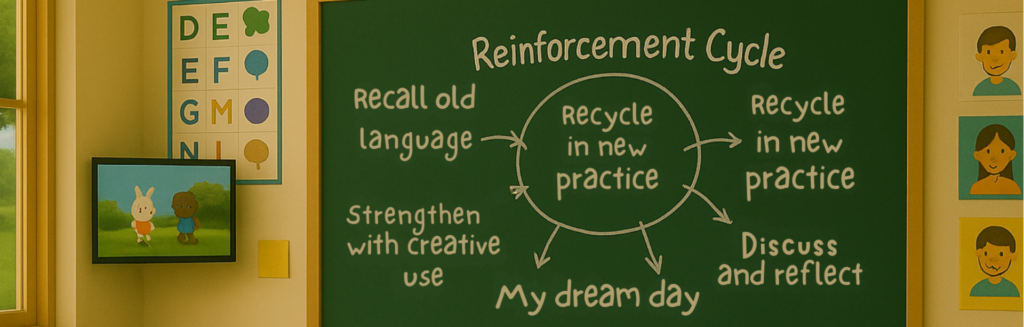
The Power of Reinforcement in Language Learning

The Power of Reinforcement in Language Learning
APR
20
Apr 20-26
Loading...
Loading...
Event Passed
Event Passed
Available after you register
Trainer Stephanie
Trainer Stephanie is a young learner specialist and teacher trainer who helps teachers build structured, engaging lessons that lead to real student language use.
Trainer Daniel
Daniel ( HTA trainer and course creator with an MA TESOL. He specializes in young learner teaching and shares practical, teacher-friendly strategies through workshops, talks, and training sessions.
Lock You're currently previewing this session. Browse the timeslots, then register for the course to reserve one.

Description

Session 6 focuses on how all parts of the lesson come together to support independent language use over time. Even when lessons are well planned, students can still struggle to retain and reuse language if learning stops at the end of a single class. This session looks at how lessons either lead to long-term development or fade quickly once the activity ends. It shows how to design lessons that connect practice, speaking, and sentence building into a coherent learning pathway.

You will learn how to structure lessons so students revisit and reuse language in meaningful ways. The aim is not to add more content or activities, but to strengthen connections between lessons so language becomes more stable, flexible, and available for use. Each stage of the lesson is designed to reinforce what students already know while gradually extending it.

We will break down common issues that limit long-term progress, such as isolated activities, lack of review, or lessons that feel complete but do not transfer to future learning. You will learn how to plan simple review moments, reuse familiar structures, and design tasks that help students recall and apply language without starting from zero each time.

This session also explores how to support greater student independence. You will learn how to reduce reliance on the teacher, encourage self-correction, and create opportunities for students to take more responsibility for using language accurately and confidently. By the end, you will have a clear framework for connecting lessons across time, helping students move from supported practice to more independent, meaningful communication.

What You'll Learn

In this session, you will learn how to connect lessons so language development continues beyond a single class. You will design lesson structures that help students revisit, reuse, and strengthen language over time, leading to greater independence and more confident language use with less reliance on the teacher.

Key learning topics

  • Connecting lesson stages to support long-term language development
  • Designing simple review and retrieval moments that strengthen retention
  • Reusing familiar structures to build confidence and fluency over time
  • Reducing student dependence on the teacher through guided independence
  • Encouraging self-correction and active language use
  • Creating lesson pathways that support sustained progress across lessons

Coming to mobile soon

In the meantime, please access on desktop.